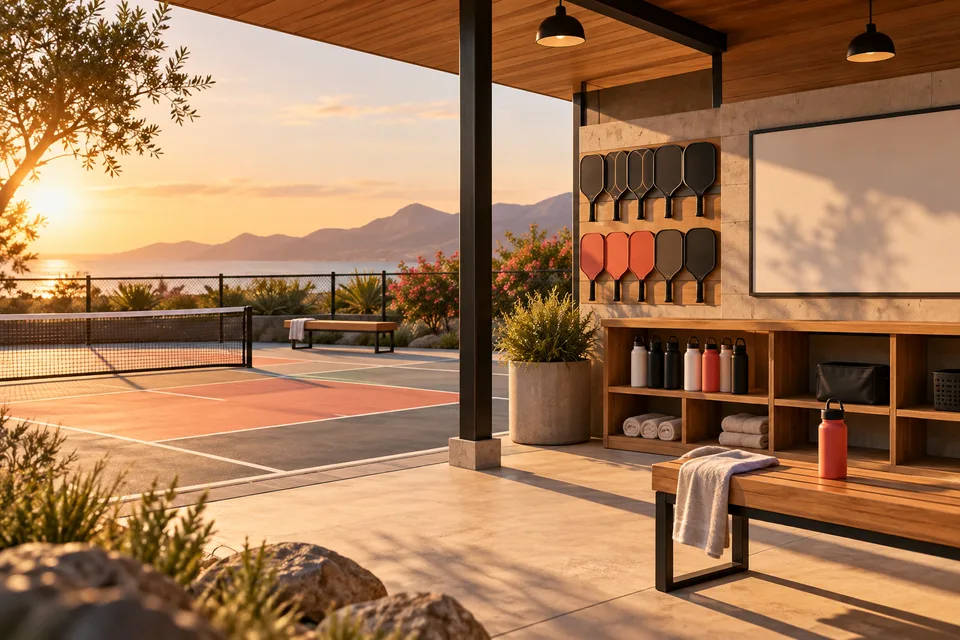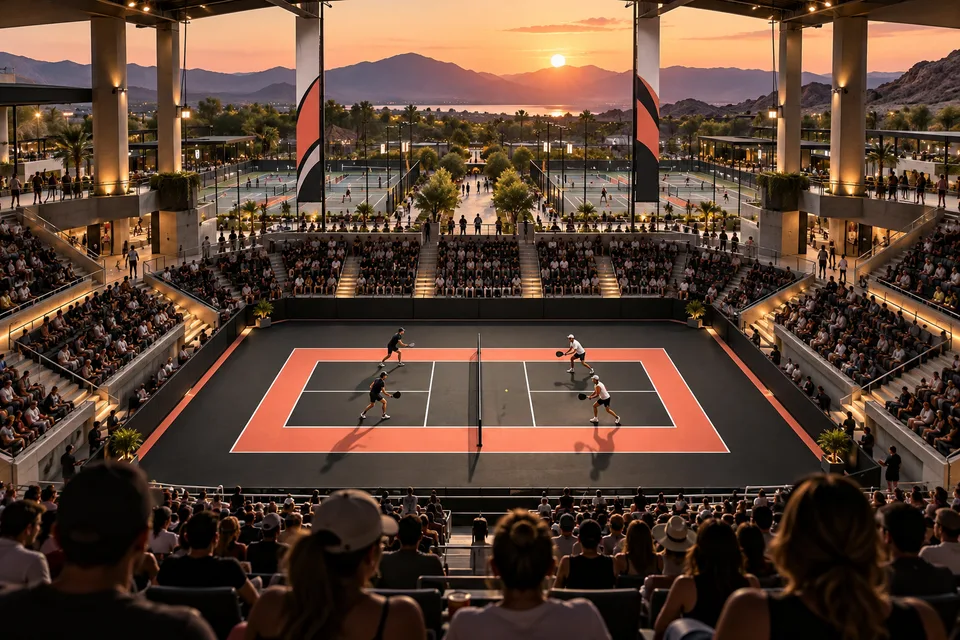
A ticket buys the right to watch. A court booking buys the right to play. Much of the argument about pickleball’s commercial future becomes clearer if those two transactions remain separate for a moment.
The spectator wants a compelling contest, recognizable competitors, a dependable schedule and a good view. The recreational player might want a compatible partner, a predictable place in the rotation and somewhere to put a bag. They can be the same person. That does not make the two purchases interchangeable, or give the organizations supplying them the same cost structure.
The distinction matters whenever an event announcement becomes a case for building a club, or a busy public park becomes evidence that a professional competition will attract paying viewers. Both are plausible opportunities. Neither inference completes itself. The useful comparison is between what each organization can actually offer, and what evidence would show that its offer is working.
On the left: a competition that people choose to watch
Professional competition organizes attention around a limited number of matches. Its audience can include people who never enter the venue. Distribution, production and the identities attached to teams therefore matter alongside the physical courts. A seat is one product within a larger entertainment offer, rather than the entire business.
The league’s published viewing plan for the 2026 MLP Finals makes the distribution product concrete. For Sunday, 30 August, it directed viewers first to Pickleballtv, then to a noon–1 p.m. Eastern window on CBS, with continuing streaming coverage and arrangements for a possible additional match. One contest was packaged for overlapping audiences across outlets. The plan documents an offered broadcast window, not the number who watched or the money the league received. That is nevertheless a different operating task from allocating an evening of neighborhood court bookings.
An organizer can incur costs well before a spectator arrives: venue preparation, production arrangements, staffing, travel and contractual commitments. Some costs move with attendance and some do not. More ticket revenue may improve the result, but a full grandstand alone cannot reveal which commitments were made or who ultimately carries them.
The PPA Tour’s commercial-partnership page shows a separate offer to brands: intellectual-property rights, experiences, digital media, hospitality and retail. It names Carvana as title partner and distinguishes official categories including nutrition and healthcare. Those categories explain what an organizer can sell beyond a seat. A partner may want an association it can use elsewhere or a direct encounter with prospective customers. The page is the seller’s marketing material, not audited evidence of the returns promised to each buyer; its advertised media value should not be relabeled sponsor cash revenue.
Even audience size needs a definition. People entering a venue, tickets issued, unique stream viewers and repeated video plays are different observations. A strong result on one measure can be valuable without becoming a strong result on every other measure. Any comparison between seasons should preserve the definition instead of selecting whichever number looks largest.
On the right: a place people choose to return to
A recreational venue sells access to a recurring activity. Its scarce resource is a usable court at a time people can attend, supported by whatever service the venue promises. The same physical space can be sold repeatedly across a week. The challenge is making enough of those occasions useful without making the popular ones intolerably crowded.
There are several possible offers within that description. A member might pay for advance booking, a coach might rent predictable teaching time, and a casual player might purchase one session. Those uses can complement one another. They can also compete for the same evening. A club’s pricing and calendar are therefore connected decisions, even if different staff manage them.
The venue’s customer relationship continues after the exciting first visit. Someone has to explain which session fits, what happens when a partner cancels and why the advertised court is unavailable. These are ordinary operating details. For a player deciding whether to return next week, they may be more consequential than a distant professional result.
A large number of first visits can mask a weak recurring offer. Conversely, a modest venue with dependable repeat play can provide a useful service without producing a spectacular launch. The appropriate evidence includes attendance over comparable periods, use by time of day, renewal behavior where applicable and the experience of people who stop coming.
The same dollar cannot be counted twice
Imagine a fictional venue that receives an event hire payment while giving up several ordinary sessions. The payment belongs in its accounts. The displaced session revenue belongs in the comparison as well, along with costs avoided or added. This is an accounting example, not a forecast for an actual club or a claim that event hire is usually unattractive.
There can be benefits beyond the payment: equipment improvements, staff experience, publicity or new relationships. A careful proposal describes those benefits and identifies who receives them. It does not treat publicity as cash available to pay the next electricity bill. Nor should it assume that a temporary event installation becomes a permanent improvement without further work.
The host city has a third perspective. Visitors may spend locally even if the event organizer loses money. A profitable organizer may purchase services from outside the area. Those are compatible outcomes because the business and the geographical economy have different boundaries. Local benefit, operator profit and resident access cannot be substituted for one another.
The International Association of Event Hosts’ economic-impact guidance emphasizes additional spending within a defined host economy, accounting for activity that would have occurred anyway, displacement and money leaving the area. It also cautions against dividing direct economic impact by public investment and calling the result a return on investment. This is a narrower and more useful test than adding every visible purchase to an impressive total.
For a public venue, some of the most important consequences are not purchases at all. Losing a familiar session can disrupt a group whose participants have arranged transport or care around it. That does not automatically outweigh the event. It means the calendar has an opportunity cost that deserves an explicit decision and adequate notice.
The bridge has several missing planks
There is a credible route from watching excellent players to trying the sport. It is also a sequence of separate steps: becoming interested, finding an entry point, attending, having an experience worth repeating and locating another suitable occasion. A break anywhere along that route can leave strong attention alongside weak local participation.
Consider the difference between an event advertisement and a useful first-session invitation. The former tells someone what to watch. The latter needs a place, a time, an explanation of equipment and a realistic account of who can join. A link to a general booking page may be inadequate if the newcomer cannot interpret its levels or find an available slot.
Capacity can make successful promotion awkward. If existing sessions are already full, a surge of interest may generate waiting lists rather than more play. The response could involve additional hours, a separate introduction session or cooperation with another venue. Which option works depends on local resources. Awareness itself does not produce the staff or space to deliver it.
Attributing subsequent activity requires restraint. Someone attending a beginner session after an event may already have planned to start. A question about how they heard of the session provides useful information but is not, by itself, a controlled estimate of the event’s causal effect. Follow-up can examine whether those particular newcomers return, with appropriate privacy and a proportionate record.
The pathway also works in the other direction. Familiarity with playing can help a spectator appreciate a difficult shot or a tactical decision. That is a reason to think about connections between recreational and professional offers. It still does not establish how much any particular fan will pay, or which style of broadcast that person will prefer.
A shared venue needs two calendars
Huntsville’s John Hunt Park operating information provides the other side in unusually practical detail. It lists 24 covered, lit competitive-play courts and one elite-play court. The published court hours are 8 a.m.–9 p.m. daily; the recreation building follows a shorter weekend timetable, and the page ties public restroom availability to that building’s hours. A nominally available court and the supporting service do not have identical calendars. That distinction matters to a repeat player even when neither appears in an event’s audience figures.
For any comparable project, the practical questions start with the year rather than the event weekend. How much time remains for ordinary sessions? What setup and removal periods sit around a tournament? Who restores the venue afterwards? A calendar that counts only the days of competition can underestimate the interruption, just as one that ignores shared improvements can underestimate the benefit.
Allocation should be understood before a successful event creates pressure for another booking. A clearly published approach allows residents, organizers and staff to plan. Last-minute exceptions may sometimes be necessary, but repeated exceptions can quietly create a different operating model from the one the public was promised.
A useful comparison would keep ordinary sessions visible before and after the event, including setup and removal days. A temporary rise in visitors could accompany displaced bookings; an improvement funded for the tournament might support play afterward. The venue needs both records to judge the exchange. Looking only at the event month loses the part of the bargain that regular users experience next Tuesday.
The financial arrangement should identify responsibility for wear, damage, additional services and cancellation. These details are specific to the contract and jurisdiction; they are not supplied by a generic participation-growth statistic. A strong commercial partner can make a venue more sustainable. The agreement still needs to explain how the venue is protected if expectations are not met.
Read the ledgers together, after reading them separately
For a professional competition, a serious assessment asks whether its audience and commercial relationships support its commitments over time. For a recreational venue, it asks whether people can reliably obtain the play and service they value at a sustainable cost. For a public owner, it also asks how access and local benefits are distributed. The answers can differ without any of the observers being mistaken.
This distinction makes collaboration more demanding, but also more credible. An event can fund an improvement whose ordinary users genuinely need it. A club can host an introduction program that gives spectators a practical route into play. A city can negotiate a calendar in which a tournament’s temporary disruption is understood and the longer-term offer remains dependable.
What should be resisted is the automatic transfer of evidence: a prominent investor becomes proof of a club’s prospects, a full community session becomes proof of broadcast demand, or a busy event weekend becomes proof of an annual local surplus. Each observation belongs to a particular question. Moving it to another question requires an argument and, usually, more information.
A productive partnership would put something tangible on both calendars: a professional event that can attract an audience, and dependable local sessions before and after the temporary stands come down. The budgets should show who pays for each. An exceptional weekend and an ordinary Tuesday can strengthen one another, but somebody has to build the connection. The local club’s value lies in being there again next week, with a usable court and a place for the next player.
Sources & context
This article draws on the sources linked in the text. Analysis and illustrative scenarios are identified separately from reported findings.
- published viewing plan for the 2026 MLP Finals
- commercial-partnership page
- International Association of Event Hosts' economic-impact guidance
- John Hunt Park operating information