A portable net trolley parked beside a gate can change the usability of a court without changing a single line on the surface. So can a locked toilet, a booking process that requires a telephone call nobody answers, or a session whose players do not understand the wheelchair rules. Accessibility is vulnerable to ordinary operating decisions.
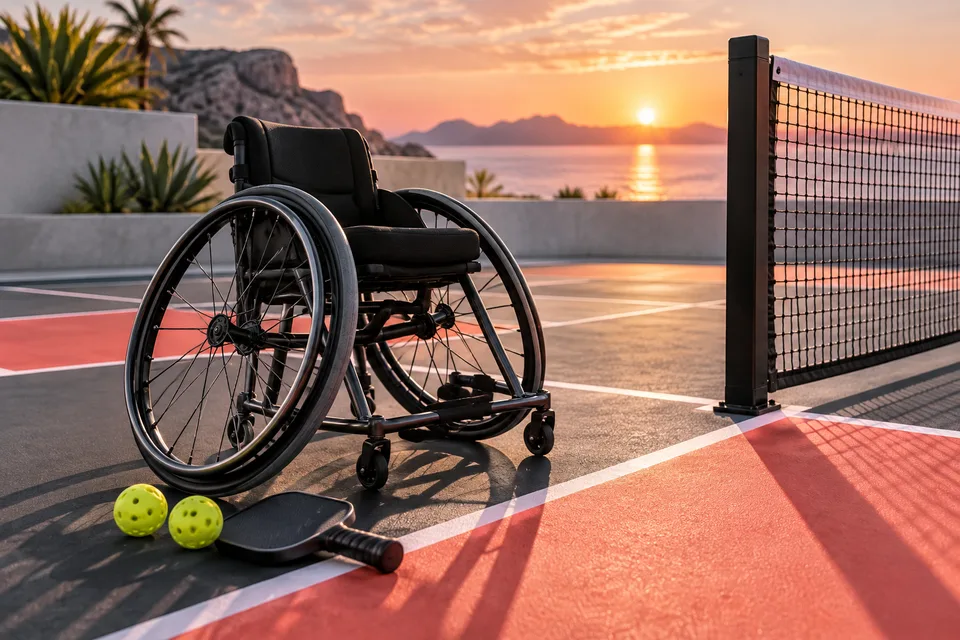
Pickleball has formal adaptations for wheelchair play. USA Pickleball’s 2026 quick reference sets out the relevant rules, including a two-bounce allowance and provisions about wheel positioning. That is essential information for players and officials. It does not describe whether a particular venue can support a good visit.
The five checkpoints follow a player’s whole visit. At each one, ask what is promised, what actually happens and who can fix the gap. Include wheelchair players in that investigation; an organizer looking only at the court can miss a barrier before arrival or after the final game.
01 / Find the session
Start where a new participant starts: the information page. Does it explain the format, the available facilities and a reliable way to ask a specific question? The word accessible is often too broad to be useful. A player may need details about a route, a surface, a changing arrangement or the space available around a court. Precise descriptions support an informed choice.
Photographs can help if they show relevant features accurately and are kept current. A carefully framed image of the court does little to explain the gate or the path from the entrance. A plan can be useful, but a diagram that omits the route between facilities can give an incomplete impression. Information should be tested against an actual visit.
The registration process should avoid turning an access question into an invitation to disclose unnecessary personal details. Ask what arrangement or information the person needs for the activity, within a clear privacy process. Do not assume that every wheelchair user has the same needs or that a diagnosis explains how a facility should operate.
There is a continuity issue as well. If a knowledgeable volunteer answers questions through a personal account, the information may disappear when they leave. A venue-owned contact process and a maintained access description make the offer more dependable. A useful answer should not depend on finding the one person who remembers the last adaptive session.
Sport England’s Accessible and Inclusive Sports Facilities guidance addresses design and operation through several parts, including wayfinding, consultation and management. It replaces earlier guidance. That is a reminder to check the version of a reference, rather than circulate an old PDF indefinitely because its title sounds authoritative.
02 / Reach the gate
Next, follow the arrival route as a connected sequence. Consider the actual entrance people are told to use, how they reach it and what happens when the venue is busy. A theoretically available route can become obstructed by parked equipment, temporary signage, waste bins or people waiting for another activity.
The point is not to judge a venue from a single unusual obstruction. It is to identify how the intended route is maintained in normal operation. Who notices a problem? Who can move an obstacle? What happens if the usual gate is locked? A plan that depends on a player finding staff and asking for an improvised exception needs scrutiny.
The US Access Board’s sports-facilities guide illustrates the importance of routes connecting accessible elements. The page concerns built features and includes a provision index for ADA and ABA standards; it explicitly leaves operational issues outside its scope. The design principle is useful more widely: isolated accessible features do not create a usable facility if the connections between them fail.
Travel information belongs in this checkpoint too. A court may be technically accessible from a designated entrance while the advertised arrival point leads elsewhere. Where feasible, explain the relevant route from public transport, parking or a drop-off point. The venue cannot control every part of a journey, but it can avoid providing information that sends a person toward a known barrier.
An access audit should also be repeated under event conditions. Extra seating, a tournament desk or a sponsor display can alter circulation. A layout that works during a quiet visit may work differently when several groups arrive at once. Temporary arrangements need the same deliberate consideration as the permanent plan.
03 / Use the space around the court
The playing rectangle is only part of the sports space. A player may need to move around it, wait between games, store equipment or transfer between chairs. The relevant arrangement depends on the person and the activity. Trying to resolve all of this through a court-line diagram misses the operational area surrounding it.
USA Pickleball’s 2026 rulebook, Rule 25.A.11 recommends a 44-by-74-foot playing surface for wheelchair play, around a marked court that remains 20 by 44 feet. That is a substantially different allowance from the general 30-by-60-foot minimum playing surface. It gives the layout review a concrete starting point: preserve room for the intended movement, then check the gates, waiting areas and neighboring activity. The dimensions alone do not certify the venue.
Look at the places where waiting occurs. Is seating or shelter positioned so that someone can remain part of the group without blocking a route? Is there room beside companions? A facility can provide a nominally separate space that leaves its user socially detached from the session. Consultation can expose that problem before it becomes a permanent arrangement.
The supporting amenities matter over the length of a visit. Toilets, drinking water and changing provision may be within the wider facility but unavailable during the court’s advertised hours. An operator should describe that mismatch accurately and investigate whether it can be resolved. The existence of a facility on the site plan does not establish access at every session.
Maintenance is part of design performance. A route, gate or surface can deteriorate. A venue needs a way to report and prioritize faults whose impact is much greater for some users than others. Counting a damaged feature as available until the next annual inspection can make an otherwise accurate access statement misleading.
This checkpoint is also where a procurement decision becomes an operating responsibility. Buying a particular item does not establish who will inspect it, where it is stored or whether it is available when required. The useful question is whether the full arrangement can be relied on, including the less visible work needed to keep it functioning.
04 / Play the same session with the right rules
Once the player reaches the baseline, the rules still need to be understood. Under the 2026 USA Pickleball reference, a wheelchair player may allow two bounces before returning the ball. The reference also distinguishes the role of the large rear wheels in serving and non-volley-zone provisions. Players and officials should consult the full current rulebook for the event rather than rely on a paraphrase from the sidelines.
Those adaptations should be communicated as the rules of the activity, not negotiated as a favor every time a player joins. Requiring someone to explain and defend their participation repeatedly adds a barrier that a well-designed gate cannot remove. Organizers can reduce that burden through a concise briefing and an identified source for resolving uncertainty.
Mixed sessions need the format stated clearly. Explain who is playing under which provisions and how the rotation works. Do not infer a player’s ability or preferred role solely from the use of a wheelchair. Ask about the practical arrangement and respect the participant’s own knowledge of their play.
The task for a coach is similarly specific. A general willingness to help is valuable, but the session needs the relevant competence and a way to obtain it. An operator should be honest about what is available rather than promise specialist support that rests on an untested assumption. Collaboration with experienced adaptive-sport providers can be more useful than inventing a parallel program from scratch.
The competitive and social objectives should remain visible. A player seeking a demanding match may have different expectations from someone trying the sport. An inclusive offer can include several routes without assuming that every wheelchair user wants the same one. Where capacity is limited, explain what the session can actually provide.
There is a counterargument that formal briefings can make a small social session feel bureaucratic. The response is to keep the communication concise and routine. Clear rules reduce repeated interruptions and awkward disputes. Making the information available before the session can allow the hour itself to remain focused on play.
05 / Finish the visit, then improve the next one
The route does not end with the last point. Follow the player back through the facility at the actual finishing time. An entrance may close, staff may leave, lighting may change or equipment may be moved for the next activity. The outward journey should be part of the operating plan rather than an afterthought.
Emergency arrangements also require competent, site-specific planning and communication. A general claim of accessibility does not establish that those arrangements work. They should be reviewed through the applicable requirements and the venue’s established safety process, with relevant users involved. This article cannot replace that assessment.
Then ask about the whole visit. A player may have enjoyed the game while experiencing a serious difficulty before or after it. A satisfaction question limited to the coaching misses that information. Give people a usable way to explain what happened and an indication of who will respond.
Feedback should produce a record of actions and ownership. Some issues can be fixed quickly by changing storage or information. Others need design work or capital. Distinguishing them helps prevent an expensive future project from becoming a reason to leave an easy present barrier untouched. Equally, a small operational improvement should not be presented as resolving a structural problem it cannot address.
Participation data needs interpretation. A low number of wheelchair players at a venue does not prove there is no potential demand, especially if the route or offer has been difficult to use. Nor should a planner assume demand without consulting people. A pilot and a maintained dialogue can test the offer more honestly than either conclusion.
Consultation itself should be organized respectfully. Asking a player to identify a problem does not transfer responsibility for solving it to that player. An operator can explain the available choices, invite relevant experience and report back on the decision. Where sustained specialist input is needed, it should be treated as real work rather than assumed to be an unlimited favor from participants.
Temporary changes deserve especially clear communication. If construction closes the usual route or an amenity is unavailable, update the information before the next session and explain the actual alternative. A dated description of a limitation is more useful than a reassuring label left unchanged. People can then decide whether the revised arrangement works for them without making a trip to discover the difference at the gate.
The same discipline helps when an improvement is completed. Say which feature changed and check its relationship to the rest of the route. Installing a new entrance does not make every supporting amenity usable, while fixing one missing connection can transform the value of several existing features. Specific communication allows progress to be recognized without inflating its scope.
The five checkpoints form a chain. Finding the session, reaching the gate, using the supporting space, joining play and leaving reliably all contribute to whether the opportunity exists in practice. A rulebook can define an inclusive game. A venue has to make the rest of the visit possible often enough for that game to become part of ordinary life.
Sources & context
This article draws on the sources linked in the text. Analysis and illustrative scenarios are identified separately from reported findings.
- 2026 quick reference
- Accessible and Inclusive Sports Facilities guidance
- sports-facilities guide
- 2026 rulebook, Rule 25.A.11