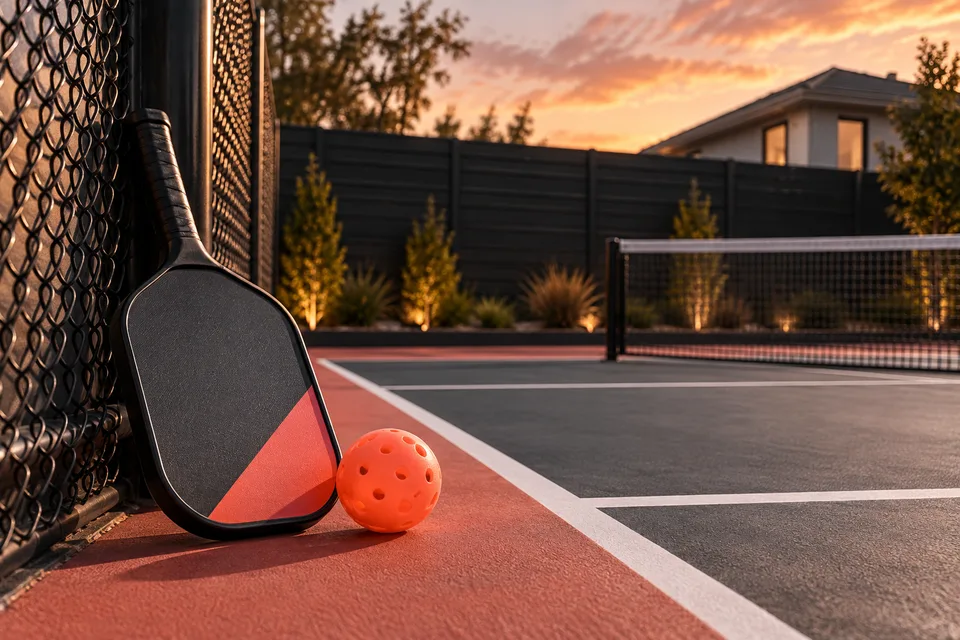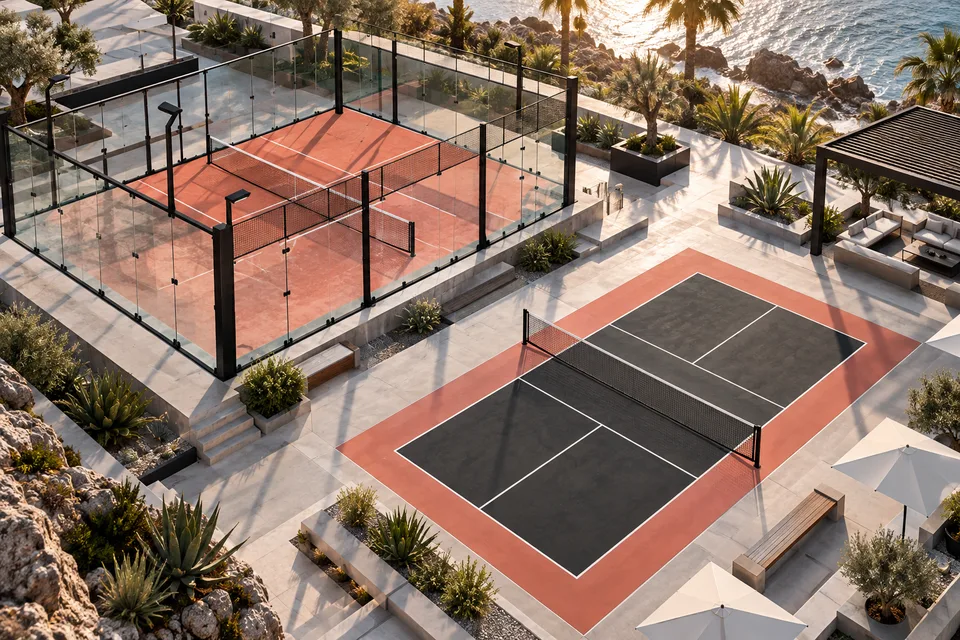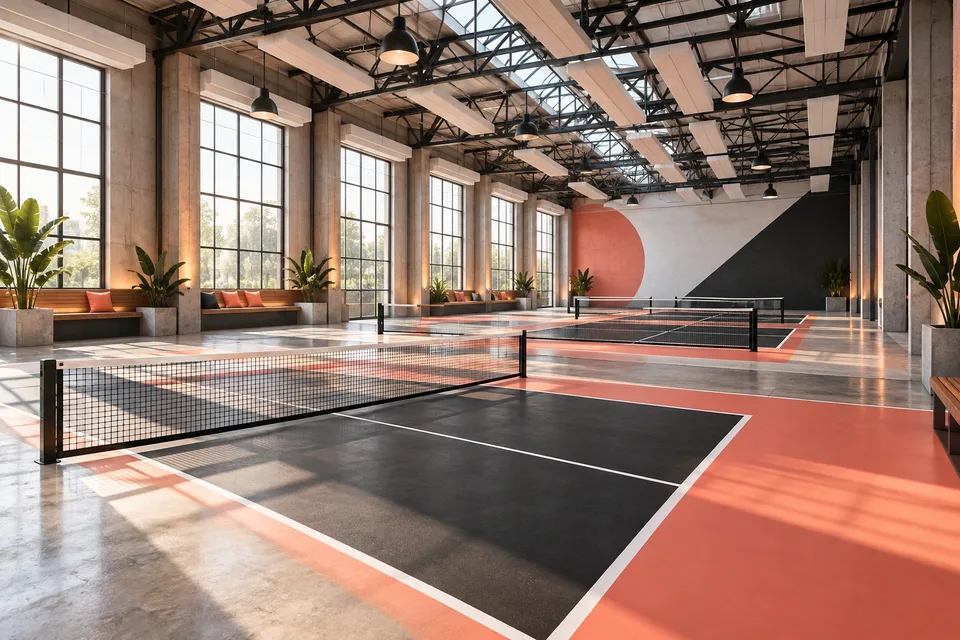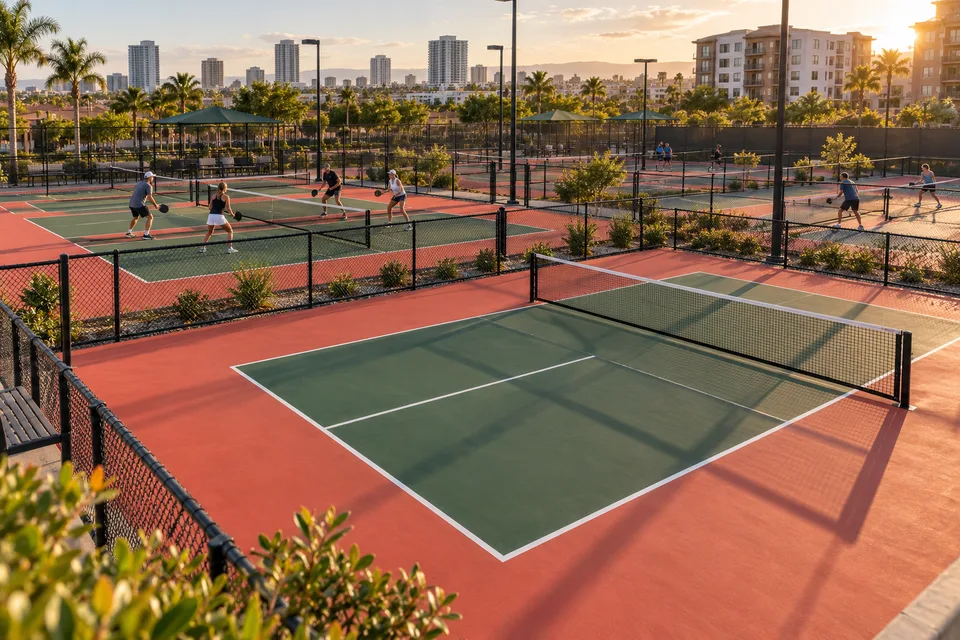
Four courts, three usable evening hours, four people playing doubles: forty-eight player-hours. That is the starting capacity of a small public venue before rain, maintenance, lessons or a disputed rotation remove anything from the timetable. It is an illustrative calculation, not an estimate of a particular park. It is also a more useful place to begin a discussion about court shortages than the national participation headline.
The headline is substantial. The Sports & Fitness Industry Association’s 2026 release puts US participation at 24.3 million people in 2025, compared with 4.2 million in 2020. It counts 7.5 million people as core players, defined as playing at least eight times a year. Those are people, not simultaneous bookings, annual memberships or weekly attendance. Dividing either number by a national court inventory would produce an impressive-looking ratio and a surprisingly poor building brief.
The missing variable is time. A court available on a Tuesday morning is not the same public resource as one available after work. A private club can add capacity without making a game affordable to a nearby school pupil. A newly painted shared court may exist in an inventory while its portable net remains locked in a shed. The planning question is how much usable play a community can obtain from its actual facilities.
The court that exists on paper
Court counts compress several kinds of supply into one unit. Dedicated outdoor courts, temporary lines in a sports hall, privately bookable courts and a tennis court available for conversion during selected sessions may all be called courts. Their calendars, surfaces, weather exposure and access rules differ. Before discussing a shortage, a city should establish which of these it is counting and what each reliably offers.
This does not require an elaborate digital twin. A modest, maintained register can record location, operating hours, booking conditions, price, lighting, accessible arrival routes and the times allocated to different activities. It should distinguish a facility that is technically open from a session that a newcomer can actually join. A venue whose website says to contact a club, whose club says to consult social media, and whose social account has not posted this season has an information barrier even if the gate is unlocked.
Supply also has a radius. A regional tournament complex and a neighborhood court perform different jobs. The first can concentrate enough courts for an event and support specialist programming. The second may allow someone to play without making a trip that consumes the rest of the evening. A city can reasonably want both. Treating them as interchangeable obscures the choice between a destination facility and everyday access.
Sport England’s place-needs work provides a useful methodological comparison: examine inequalities and local conditions before choosing interventions. Its English data cannot establish an American neighborhood’s demand. The transferable principle is to investigate people who face barriers, rather than measure need only through the behavior of those already using a venue.
What Huntsville’s roof changes
Huntsville offers a current example of a city building a substantial dedicated facility. Its John Hunt Park Recreation Center listing describes twenty-four covered, lit competitive-play courts and one elite-play court. The listing separates the pickleball complex’s hours from the recreation building’s hours, an operational detail with consequences for amenities as well as access.
Axios’s June opening report identifies the facility’s dual role in resident recreation and regional tournaments. That is evidence of an investment and its intended uses. It is not evidence that every court is continuously occupied, that the project has met all local demand, or that its design should be copied elsewhere.
The roof and lighting illustrate why physical court totals are inadequate. They can make the same footprint useful over more conditions and hours. Yet a roof does not eliminate every interruption, and lighting introduces energy, maintenance and neighborhood considerations. The relevant comparison is the additional dependable play delivered over the facility’s operating life, including the cost of keeping it available.
Programming determines who receives that benefit. Tournament days can create economic activity and a strong sporting occasion while temporarily reducing ordinary availability. Coaching can introduce new players while occupying courts. Neither use is inherently wrong. The honest approach is to account for the trade-off in the calendar instead of letting a construction announcement imply unlimited access for everyone.
Before pouring another slab
Return to the four-court evening example. Suppose the venue extends usable time from three hours to four. Under the same doubles assumption, theoretical capacity rises from forty-eight to sixty-four player-hours: a one-third increase without a fifth court. This is arithmetic, not a forecast. It says nothing about whether the extension is affordable, permitted, wanted or safe at that particular site.
Now suppose poor rotation leaves one court idle for half an hour while a queue waits elsewhere. That loses two player-hours. The number looks small against the whole session, but the experience can feel much larger to the people excluded. An occupancy average cannot explain whether one group monopolized the best court or whether beginners felt unable to enter. Capacity and fairness need separate measures.
The sensible first investigation is therefore operational. Observe a sample of busy and quiet sessions. Record actual court use, waiting time, cancellations and the reasons courts become unavailable. Ask people who leave without playing what happened. Compare school-term weeks with holidays and different weather conditions. A single crowded Saturday morning can identify a problem, but it cannot describe a year.
Data collection should remain proportionate. A recreation department does not need to track individuals continuously to discover that lights fail early or that booking rules confuse occasional players. Short, disclosed observations and voluntary feedback may answer the question. More software is useful only if someone is responsible for maintaining the information and acting on it.
Conversion has a constituency
Converting tennis space is often presented as a geometry exercise: several smaller playing rectangles fit inside a larger one. The usable facility also needs circulation, run-off space, fencing, equipment storage and a workable relationship with its neighbors. Those requirements should be checked against current USA Pickleball construction guidance, site conditions and professional design advice, rather than an internet diagram alone.
The people displaced by a conversion belong in the calculation. An apparently quiet tennis court might support a school session, informal users who do not book, or a seasonal program. Equally, a rarely used facility should not remain unchanged merely because its current users are easier to identify than potential new ones. Consultation needs evidence and an explicit account of alternatives, not a contest of the loudest supporters.
Shared lines can be a practical interim choice where schedules and storage work. They can also create confusion or leave both sports with compromised access. A pilot should say what it is testing: demand, session organization, surface compatibility or the effect on existing users. It should have an evaluation date and a way to reverse or modify the arrangement. Calling a permanent allocation temporary is not a substitute for making the decision openly.
Noise deserves its own assessment. Equipment, playing intensity, distance, barriers and nearby buildings interact. USA Pickleball’s acoustics program is relevant to equipment and mitigation, but a product category cannot establish the effect at a bedroom window. A venue that earns more hours by producing a persistent neighborhood conflict may lose those hours later through restrictions. Getting the site right can be more valuable than adding courts quickly.
A queue is evidence, but of what?
An important test is whether the queue changes when the offer changes. If an additional beginner session fills while an advanced session remains quiet, the constraint may be confidence or matching rather than the total court inventory. If every evening session fills but daytime capacity remains unused, the issue is concentrated demand. If bookings disappear when a modest fee is introduced, affordability needs investigation. None of these observations alone establishes causation, but each suggests a different next question.
Compare similar weeks before and after a scheduling change and record other changes at the same time. A school holiday, tournament or unusually pleasant weather can produce a misleading apparent effect. Ask whether improvement at one venue merely moved players from another. A systemwide gain matters more than a single facility’s attractive utilization chart, particularly when the same public budget maintains both sites.
The people not in the queue are harder to see. Someone may have stopped attempting to book, lack transport, or assume a session is for experienced players. Waiting-time data therefore needs a companion: a small amount of deliberate outreach to local groups that do not currently use the facility. Their absence should not automatically be interpreted as lack of interest, nor should a planner invent demand on their behalf.
There is a useful discipline here for enthusiasts and skeptics alike. State what observation would change the preferred decision. A construction advocate might accept that a timetable experiment should come first. A department reluctant to build might specify the persistent demand that would justify investment. Once the decision threshold is public, collecting evidence becomes a way to resolve a choice rather than a way to postpone one indefinitely.
The denominator that belongs in a budget
A capital budget buys construction. An operating budget buys the continuing possibility of play. Cleaning, resurfacing, net replacement, booking support, volunteer coordination and predictable opening are less photogenic than a ribbon cutting. They determine whether an existing court remains a useful asset. Comparing projects only by cost per installed court rewards facilities that are inexpensive to announce rather than dependable to run.
A better appraisal would examine cost per additional usable player-hour alongside distribution. The model must disclose its occupancy assumptions and test a lower-demand case. It should also show who can reach the facility, what they pay, and which groups gain or lose access. A project with a higher unit cost may still be justified if it serves people currently excluded. The calculation informs the public decision; it does not make the decision automatically.
There are limits to optimizing existing space. A park can genuinely be full. A remote, poorly connected site cannot be fixed by better booking software. Extending evening play may be incompatible with nearby homes. Where evidence shows persistent unmet demand after reasonable operational improvements, new construction is a legitimate response. The argument for measuring useful hours is not an excuse to refuse investment.
Nor should every venue be filled to theoretical capacity. Beginners need room to learn. Adaptive sessions may require different arrangements. Families value a game whose timing is uncertain. Resilience means keeping some slack for disruptions and ordinary human variation. A system that maximizes occupancy at every minute can be efficient on a spreadsheet and hostile in person.
The participation surge gives cities a chance to establish enduring recreation infrastructure while enthusiasm is high. It also creates pressure to announce something immediately. The strongest response is a sequence: understand local barriers, make existing facilities genuinely usable, test allocation rules, and build where the remaining gap justifies it. Publish enough information for residents to see why that sequence was chosen.
The next public report should still count courts. It should also tell a worker whether there is a dependable evening session, a new player whether they are welcome, and a neighbor how impacts are managed. A sport has matured when the infrastructure around it can answer those ordinary questions. The number of painted rectangles is only the beginning.
Sources & context
This article draws on the sources linked in the text. Analysis and illustrative scenarios are identified separately from reported findings.
- 2026 release
- place-needs work
- John Hunt Park Recreation Center listing
- Axios's June opening report
- USA Pickleball construction guidance
- acoustics program