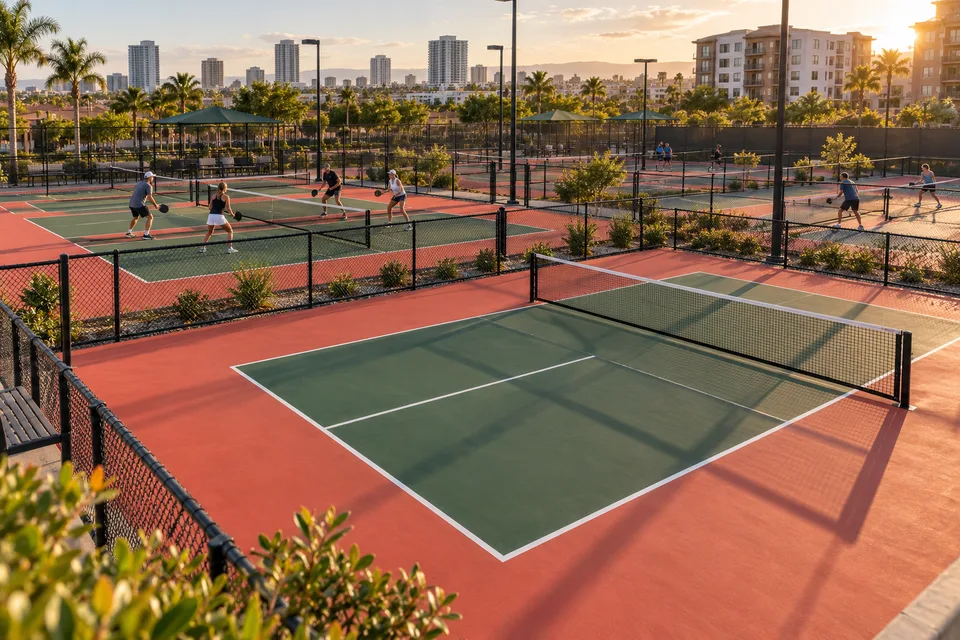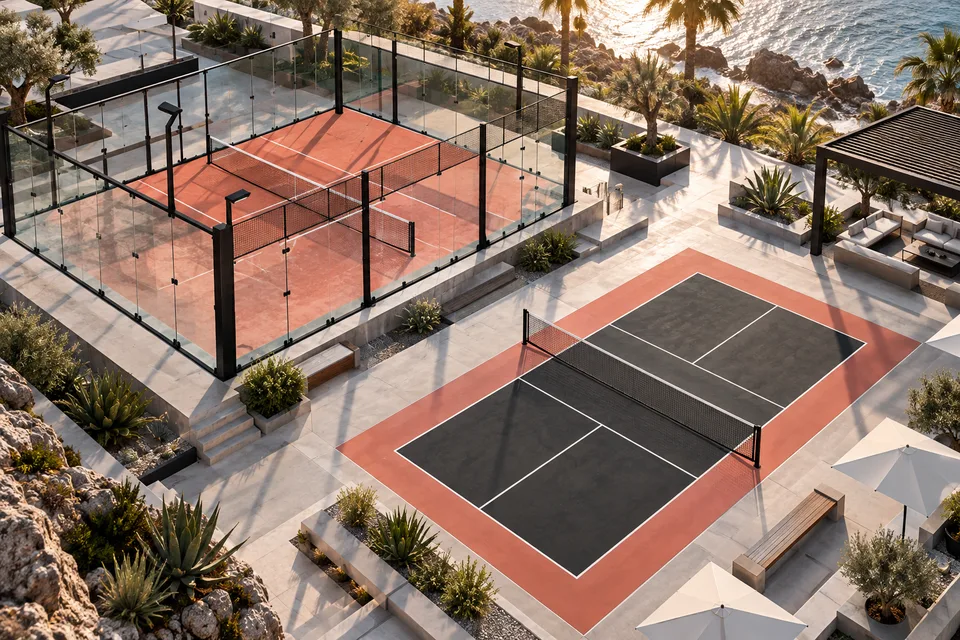
At the baseline, the next paddle impact is expected. Through a bedroom window, the same impact can interrupt an entirely different afternoon. The player and the neighbor occupy different acoustic environments, even when a fence is all that separates them. A court operator has to understand both. The equipment label is one piece of evidence; the distance, buildings, opening hours and character of the sound complete the site question.
An equipment test answers a narrower question: what acoustic output was produced under specified conditions? A site assessment asks what reaches relevant places, against what background, over what period and through which paths. Confusing those questions encourages a familiar procurement error. A quieter product is purchased, the neighborhood problem persists, and each side concludes that the other is being unreasonable.
Follow a single conceptual impact from paddle to room. The journey passes through three linked problems: the source, its propagation and the receiver. There is potential for improvement at each stage, but no product can be judged independently of the place where it will be used. The practical aim is a defensible combination of equipment, design and operation.
At the paddle
USA Pickleball’s acoustics program distinguishes Quiet Category and Noise-Reduced Category designations. Those labels are useful starting points for understanding what manufacturers and the sport’s governing body are trying to achieve. They should be read with the program’s current definitions and the exact product information, rather than treated as interchangeable descriptions of anything advertised as quiet.
The association’s March 2024 explanation describes work on paddles, balls and facility materials. The range matters. A ball-paddle combination produces an impact; buying one component does not make the other irrelevant. A venue considering equipment rules needs to know what was tested and what players will actually use.
The acoustic-equipment listing is a place to inspect the designated products and any reported values. A number detached from test distance, configuration and metric is difficult to interpret. A lower reported output in one controlled comparison is not a prediction of the level at every surrounding home. Comparing values from different methods can create precision without comparability.
Competition eligibility is a separate question. Equipment can be developed for quieter recreational use under a category whose requirements differ from the equipment a particular tournament permits. An organizer should check the current official rules and equipment requirements for the event. A neighborhood policy and a competition policy may have different objectives and need an explicit arrangement between them.
For an everyday venue, the implementability of an equipment rule matters as much as its technical promise. Will loan equipment be available? Can visitors understand the rule before arriving? Who handles a disagreement? A policy that assumes every newcomer has already bought a particular product can reduce access while still failing to secure consistent compliance. Those operating details belong in the trial budget.
Across the fence
Once sound leaves the impact, distance and the physical setting matter. A barrier can interrupt a direct path, but its position, height, continuity and relationship to nearby buildings affect what it achieves. A decorative screen with gaps is a different intervention from an appropriately specified acoustic barrier. Visual enclosure and acoustic performance should not be assumed to coincide.
The Federal Highway Administration’s noise-barrier design handbook explains physical considerations such as diffraction and the importance of geometry. Its road-noise context is different from pickleball and cannot supply a court-specific performance guarantee. The transferable point is that a barrier is part of a source-path-receiver system; attaching a material to a fence is not a complete design specification.
A barrier that helps at ground level may provide less protection for an elevated receiver. Reflections and openings can create other paths. Wind and atmospheric conditions can influence propagation. These are reasons to assess relevant locations under representative conditions, rather than choose the most convenient measuring point and generalize from it.
The site itself offers choices before a barrier is purchased. Court orientation, the location of the nearest active playing area, circulation and the use of intervening structures can affect the arrangement. Design should also account for shade, visibility, maintenance and safe movement. Solving one impact by creating an unusable or poorly supervised venue is a poor exchange.
An existing court has fewer choices than a proposed one, which makes early assessment valuable. Once a community has invested in a particular footprint, each proposed change can become a dispute over sunk costs. A design-stage acoustic brief gives neighbors and players something more concrete to discuss than competing assurances that the sport will be fine or intolerable.
Through the window
The receiver brings another set of conditions. A measurement at a property boundary, outside a window and inside a room may answer different questions. Background activity varies by time. Repeated short impacts can be noticeable even when a longer averaging period produces an unremarkable result. A useful assessment should state its metrics and explain why they fit the question being asked.
This is where a single average can become politically convenient and practically inadequate. It can hide the pattern of impacts, while a selected peak can exaggerate how continuously an event occurs. The proper response is a measurement plan that captures the relevant character and duration, with the conditions documented. It should allow someone else to understand what was observed and what was excluded.
Phone recordings can communicate a concern, but differences in microphones, automatic processing and playback make them a weak basis for comparing levels across sites. A dramatic recording played through loud speakers does not reproduce the original exposure. Neither does the absence of a dramatic recording show that there is no problem. Where a formal decision depends on acoustic performance, suitable equipment and qualified assessment are justified.
Room use and timing matter too. A court’s busiest period may coincide with the hours a nearby household is at home. Opening an extra early-morning session changes more than the annual number of impacts. It changes when people experience them. An operating schedule is therefore one possible mitigation, with benefits and costs that should be made explicit.
Any applicable local requirements need to be checked for that location and the current date. Equipment labels are not legal findings, and this article does not offer a universal compliance threshold. A venue should obtain the relevant local interpretation and a site-specific professional assessment where needed. Borrowing an apparently permissive number from another jurisdiction is a poor basis for a durable agreement.
A city has to distribute the game
San Francisco’s September 2025 staff report on tennis and pickleball planning describes the concentration of pickleball use at small neighborhood parks, with noise among several resulting conflicts. It also describes redistributing play and looking for additional underused spaces. This is a historical account of that process, not a statement that every present dispute has been resolved.
The case makes an important planning point. A heavily used local court can become a citywide destination because other supply is inadequate. The impacts are experienced by one neighborhood while the users come from a wider area. Asking that neighborhood or a single equipment rule to absorb the entire growth problem misses the geography of demand.
Redistribution can improve that balance, but it requires usable alternatives. A nominal replacement that is too far away, difficult to reach or open at the wrong times may not relieve pressure. A new destination can also concentrate impacts in another place if its assessment is superficial. The comparison needs operating hours, transport, amenities and acoustic conditions, not merely a replacement court count.
The strongest skeptical argument is that technical assessment can become a way to delay a decision everyone already understands. That can happen. A study should therefore have a defined question, a timetable and an account of how the result will affect the choice. Commissioning repeated measurements without a decision rule can exhaust trust just as surely as refusing to measure anything.
The opposite shortcut is to label objections hostility to the sport. A person can support public recreation and reasonably question a particular location or schedule. A player can acknowledge an impact and still question whether a proposed restriction is proportionate. A useful process allows those positions to coexist while the specific choices are investigated.
Consider two hypothetical operating plans that generate the same total amount of play. One concentrates the activity into predictable afternoon sessions. The other spreads smaller sessions from early morning into the evening. The annual court-hours are equal, but the experience of a nearby household may differ substantially. Whether concentration or dispersion is preferable depends on the location, the affected uses and the alternatives available to players. A single annual usage total cannot settle that choice.
There is a similar distinction between an improvement relative to the present situation and an acceptable future arrangement. A product trial might produce a measurable reduction while leaving a material concern unresolved. That result supports the claim that the intervention helped; it does not prove that no further action is necessary. Conversely, a neighbor noticing an occasional impact after a successful intervention does not automatically establish that the intervention failed. The evaluation needs an agreed question precise enough to survive those different interpretations.
Responsibilities should be clear before capital is committed. The organization installing a barrier may not be the group running open play. A club might enforce equipment rules during coached sessions while the public uses the site at other times. If performance depends on conditions nobody has the authority or resources to maintain, the design assumption is fragile. The project brief should identify those dependencies and fund the continuing work they require.
What an equipment trial should settle
An equipment trial should compare configurations under a documented method, including relevant receiver locations. It should record actual use, conditions and adherence to the rule. If possible, compare similar sessions rather than a quiet demonstration with a busy weekend. Participants need to know what success would look like before the result becomes an argument about whether the goalposts moved.
The evaluation should also ask whether the playing experience remains workable for the intended users. A materially different ball may affect expectations, coaching or competition preparation. That does not automatically defeat a quieter recreational arrangement. It means a venue may need distinct sessions or a clear explanation of its purpose. Testing adoption alongside sound can expose those needs early.
Finally, assign responsibility for keeping the arrangement effective. Screens deteriorate, equipment is replaced, opening hours drift and new users arrive. A successful initial measurement does not maintain a facility. An agreed contact process, periodic checks and a record of operational changes make a settlement more resilient than a one-off promise.
The next useful question about a quiet paddle is therefore where and how it will be used. At some sites, equipment changes may make a meaningful difference with little additional work. Elsewhere, the critical choice may concern a barrier, an hour of operation or the location itself. A quieter impact is valuable. A quieter neighborhood requires following that impact all the way home.
Sources & context
This article draws on the sources linked in the text. Analysis and illustrative scenarios are identified separately from reported findings.
- acoustics program
- March 2024 explanation
- acoustic-equipment listing
- official rules and equipment requirements
- noise-barrier design handbook
- September 2025 staff report on tennis and pickleball planning