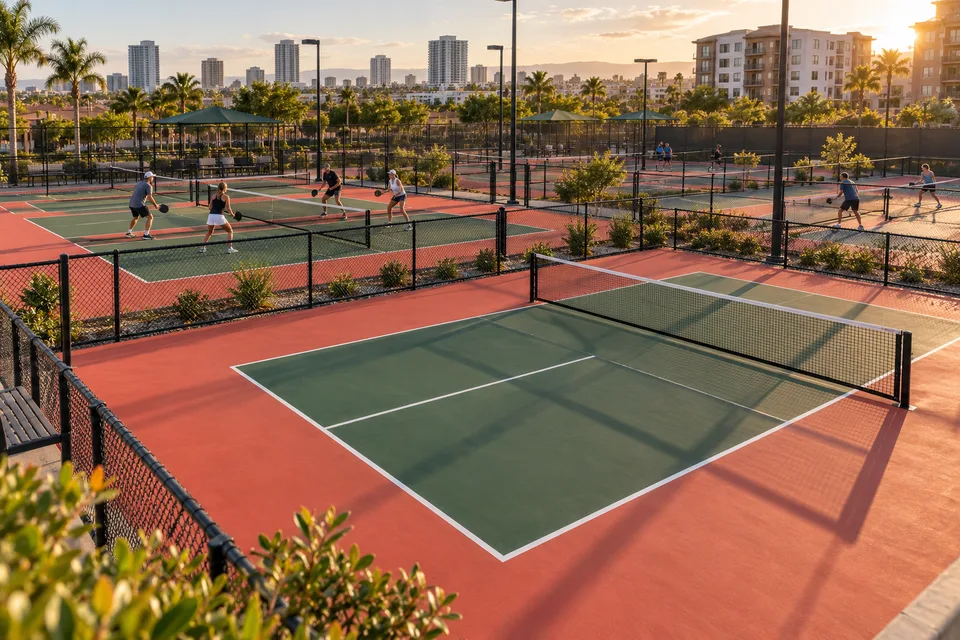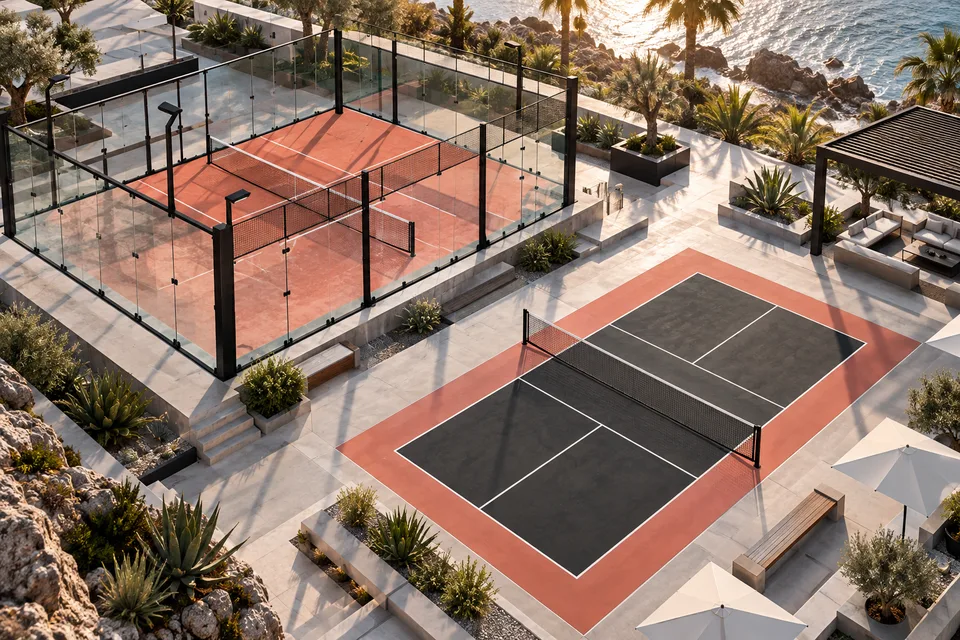
Two outdoor courts can have the same dimensions, surface and nominal opening hours while offering quite different opportunities to play. Shade arrives at different times. Lighting serves different parts of the court. A building containing toilets may close before the last booking ends. The timetable is part of the infrastructure.
Walk through an illustrative day at an imagined venue. The times below organize the planning questions; they are not weather observations or recommended safe exercise periods. Actual operating decisions should use current local conditions, official advice and the venue’s competent safety process. Changing the hour does not remove heat risk automatically.
7:00 a.m. / The first useful hour has conditions
An early session can suit some people and be impossible for others. Work, school, care, transport and the venue’s staffing arrangements determine who can use it. Moving play away from a pressured part of the day is therefore also an access decision. The people who benefit from an earlier opening may differ from those who lose a later session.
The physical conditions need attention as well. A lower sun angle can affect sightlines and glare. The relevant question is where the light falls across the actual court and its surrounding routes at the intended times of use. A general orientation recommendation is a starting point for design, not a guarantee that every morning or evening view will be comfortable.
Opening the gate has supporting consequences. Are the advertised amenities available? Can someone obtain help? Is the arrival route usable? An early court slot does not necessarily require a fully staffed recreation building, but the organization should describe the offer accurately and provide the arrangements its intended use requires.
Scheduling should also account for neighbors. An earlier start can shift sound into a period when surrounding homes are quieter. A venue cannot evaluate the benefit of extra playing time solely from the court’s perspective. The operating agreement needs to consider the site as it exists, including the people who do not use it for sport.
11:00 a.m. / The shaded square is moving
Shade is a geometry problem as well as a landscape feature. A tree, roof or screen can provide useful cover at one hour and miss the relevant place at another. An attractive photograph taken during a shaded moment does not describe the whole daily or seasonal pattern.
The US Environmental Protection Agency’s trees and vegetation guidance explains cooling through shade and evapotranspiration. Those mechanisms support the case for considering vegetation in site design. They do not establish a universal temperature reduction for every court, tree species or layout. A quoted result from another setting needs its context attached.
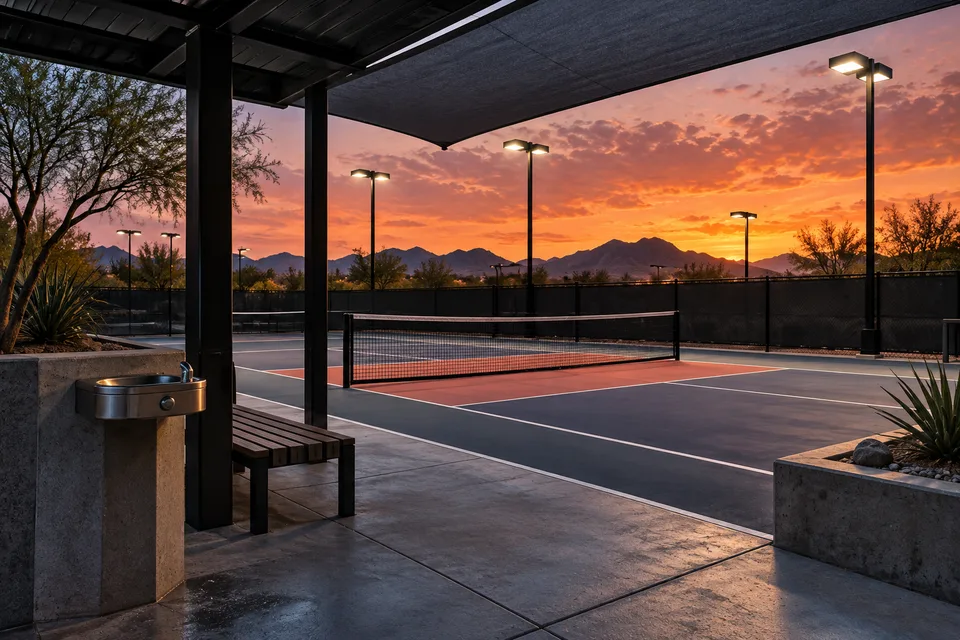
For a sports venue, distinguish shade over waiting and resting areas from shade over the playing surface and the arrival route. Each can be valuable, and their design constraints differ. A site can improve the experience around a court even when covering the entire playing area is impractical. The benefit should be described specifically rather than summarized as the whole facility now being shaded.
Trees also take time to establish and require continuing care. A planting plan needs a realistic account of growth, survival, water and maintenance under local conditions. Counting a newly planted tree as equivalent to a mature canopy can inflate the apparent immediate benefit. Temporary and permanent measures may need to be coordinated over several seasons.
Structures have a different set of dependencies: design, foundations, drainage, maintenance and the relationship to light and airflow. A canopy purchased for rain protection should not automatically be credited with every heat-related benefit a reader might associate with the word covered. The actual arrangement needs assessment.
2:00 p.m. / A forecast is information, not an opening instruction
The National Weather Service’s 2026 heat-tools guide separates three questions. Heat Index combines air temperature and relative humidity for shady, light-wind conditions. WBGT incorporates additional weather factors, including wind and solar exposure, to help assess heat stress during outdoor activity. Experimental HeatRisk places a day’s forecast in a local and seasonal health-impact context, including the duration of unusual warmth.
A lower WBGT number than a Heat Index number therefore does not mean that one forecast has discovered a safer court. They use different measures. The NWS forecast-tools explanation describes their intended uses; local activity guidance has to be matched to the relevant tool. A daily category also cannot stand in for a measurement at one exposed playing surface at one moment. Put the metric’s name beside its value whenever the venue communicates a decision.
An operator needs a documented process for turning relevant information into a decision. Identify who checks conditions, which applicable guidance governs the venue, how changes are communicated and what happens to affected bookings. This article does not supply a universal closure threshold or a personal medical recommendation. Those decisions depend on the setting and the people involved.
Consistency matters because cancellations redistribute costs. Players may have traveled, a coach may have committed time and a group may have paid in advance. Clear terms and timely updates can reduce avoidable frustration while preserving the ability to respond to conditions. A policy that is hidden until a dispute occurs is a weak operating tool.
Keep the source, metric and check time in the operating record, alongside the decision and the next planned review. That allows staff to update an announced session when the forecast changes, instead of reconstructing the decision from memory after people have traveled.
5:30 p.m. / Demand and conditions do not follow the same clock
After-work demand can be intense precisely because many people have little flexibility. A venue that becomes more usable later in the day may therefore create valuable access without adding a new playing rectangle. Whether it can do so depends on the physical site, permissions, neighborhood relationship and supporting operation.
This is where the definition of usable hours matters. The theoretical capacity of a court available for ten hours is not the same as ten hours of suitable demand under appropriate conditions. A planning model should identify which hours are expected to be used, by whom and under what assumptions. Otherwise, a low cost per theoretical player-hour can conceal a scarce and expensive peak period.
Do not assume that every empty afternoon slot can absorb an evening queue. The people waiting may be unable to attend earlier. A discount can change a price constraint while leaving a time constraint untouched. Investigating why a slot remains empty is more useful than labeling the audience irrational for choosing the same popular hour.
There may be value in differentiated programming. A venue can place certain activities at times that fit their participants while protecting a dependable general offer. The arrangement should follow actual consultation and operating evidence. It should not assign groups to less desirable hours simply because their schedules are presumed to be flexible.
8:00 p.m. / Lighting changes more than visibility
Lighting can extend the opportunity to play where the site and operating arrangements support it. USA Pickleball’s lighting guidance emphasizes uniformity and glare control. The relevant design question is how the installed system serves the playing area and surroundings, rather than how bright the equipment can appear in isolation.
Huntsville’s John Hunt Park facility page makes the supporting-hours question unusually visible. Its listed Saturday schedule closes the recreation building at 2 p.m. while the pickleball complex continues to 9 p.m.; public restrooms are described as inside the building during its opening hours. The seven-hour gap is a reason to check what amenities are available for a later visit, rather than infer them from the court booking. The page says schedules can change.
Energy, inspection and replacement belong in the decision to extend hours. A capital grant for lighting does not establish who will maintain it or fund its operation. Controls should be understandable to the people responsible for the venue, including what happens when a booking overruns or a fixture fails.
Light beyond the playing area also matters. Paths, gates and transport connections form part of the outward journey. Illuminating the court while leaving its users uncertain about the route back can produce an incomplete improvement. The wider design should follow relevant requirements and site-specific professional advice.
The same is true of spill and neighborhood impact. Better aiming or control may help in an appropriate design, but the result should be evaluated at the relevant places. A claim about an efficient light source is not automatically a claim about an acceptable site arrangement. Equipment performance and facility performance need to remain distinct.
After closing / The next season is already being designed
Review the operating record over time. Which sessions were disrupted, which amenities failed to align and which hours consistently attracted demand? Retain the context, including season and weather, so that a short spell does not become an annual conclusion. A small, maintained record can guide the next investment more effectively than a large unstructured collection of complaints.
Separate a problem that can be addressed through the timetable from one requiring physical work. A reliable opening process may recover useful hours quickly. A structural shade or lighting project has different costs and lead times. Combining the two can be sensible, but each should be credited only with the benefit it can plausibly deliver.
Count the supporting capacity, too. Suppose an explicitly fictional venue adds two hours to each of four courts on three evenings a week. That creates twenty-four additional scheduled court-hours. It does not establish twenty-four additional hours of actual use, or say anything about safe conditions. If the same change leaves the only accessible toilet unavailable, the numerical gain can coexist with a reduced practical offer for some visitors. A useful evaluation records both the added schedule and what accompanies it.
The alternative investment belongs in the comparison. A sheltered waiting area could improve many existing sessions without extending the timetable. Fixing an unreliable lighting control could restore advertised access without buying more fixtures. These are different benefits, so a proposal should explain whose problem it solves and which observation would demonstrate improvement. An operator can then revisit that observation after installation, rather than treating completion of the works as the entire result.
Distribution deserves a place in that review. A site can gain total operating hours while becoming less convenient for a particular group. People who rely on limited transport, specific work schedules or supporting amenities may experience the change differently from players with more choice. The average should not erase that difference.
There is a limit to extending the day. The most responsible decision at a particular site may be to protect a shorter, dependable offer and provide alternatives elsewhere. More opening hours are not inherently better if they depend on conditions the operator cannot sustain. A court’s value includes the reliability of its public promise.
The next investment might be a shaded waiting area, better evening lighting or keeping a supporting building open for the last session. Its value depends on the hours it makes dependable for the people meant to use the court. Record those hours through a season, including closures and the amenities actually available. Then the next budget conversation can compare an extra feature with an extra opportunity to play, at the time that opportunity is needed.
Sources & context
This article draws on the sources linked in the text. Analysis and illustrative scenarios are identified separately from reported findings.
- trees and vegetation guidance
- 2026 heat-tools guide
- forecast-tools explanation
- lighting guidance
- John Hunt Park facility page